
Newsletter Subscribe
Enter your email address below and subscribe to our newsletter
Enter your email address below and subscribe to our newsletter

 Byadmin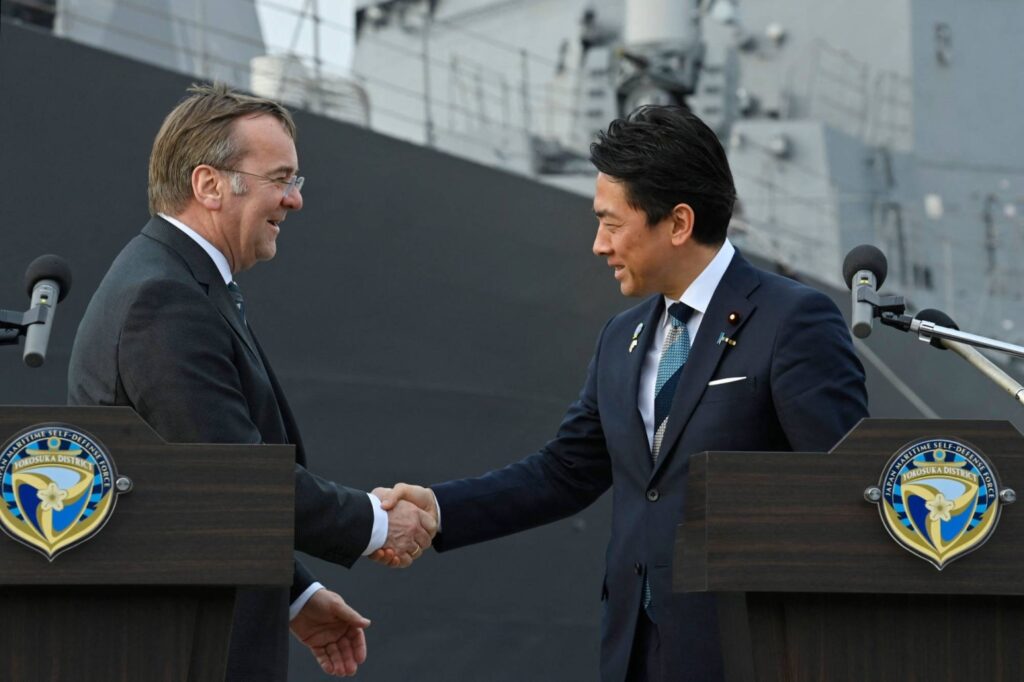
The defense chiefs of Japan and Germany have agreed to expand military cooperation and ramp up activities between their countries’ armed forces as Tokyo and Berlin seek closer alignment in response to an increasingly volatile global security environment.
Following an hourlong meeting Sunday at the naval facility in Yokosuka, Kanagawa Prefecture, Defense Minister Shinjiro Koizumi and his German counterpart, Boris Pistorius, pledged to step up cooperation “in various forms” across a wide range of defense-related areas, including military-industrial cooperation.
To address the challenges facing the international community and to strengthen deterrence, “it’s more important than ever for the two countries to work closely together,” Koizumi told journalists in a press briefing held at the naval base. This will include regular defense consultations, including on how to respond to potential crises.
Pistorius, who is on a two-day trip to Japan, said the two sides are also exploring the possibility of signing a visiting-forces pact that would facilitate reciprocal troop deployments.
Speaking to The Japan Times, German Secretary of State for Defense Nils Hilmer said that as the strategic partners step up cooperation, they are looking at ways to facilitate larger and more complex joint military activities in each other’s territories.
“What we want to see is even closer cooperation between our armed forces … with significantly lower bureaucratic hurdles,” Hilmer said. “Such a deal would make it easier to exchange personnel, to exercise jointly and to learn from each other.”
To strengthen its network of international defense partnerships, Japan has signed three “reciprocal access agreements” since 2022 with Australia, Britain and the Philippines. It is also finalizing one with France and negotiating another with Canada.
The German defense chief’s Japan trip marks the first leg of a broader regional tour that will also take Pistorius to Singapore and Australia, underscoring Berlin’s increasing strategic focus on the Indo-Pacific.
Japan and Germany, both U.S. allies, have embraced the argument that the security of Europe is “inseparable” from that of the Indo-Pacific region, with both governments wary of what they have described as attempts to unilaterally alter the status quo in the region — a veiled reference to concerns over China’s growing regional assertiveness.
Berlin’s growing engagement in Asia is not merely rhetorical. The Bundeswehr has expanded its regional footprint in recent years through naval deployments, including to Japan, and its participation in multinational exercises, reflecting a more outward-looking defense posture.
Tokyo, for its part, has welcomed deeper European involvement as it seeks to diversify its security partnerships beyond its alliance with the United States amid growing pressure from Washington that U.S. allies and partners will need to do more for their own defense.
Pistorius was accompanied by a delegation of senior representatives from major German defense firms such as Airbus Defence and Space, MBDA, Diehl, Hensoldt, Quantum and Rohde and Schwarz, highlighting the industrial dimension of the visit and Berlin’s intent to link strategic cooperation with business opportunities.
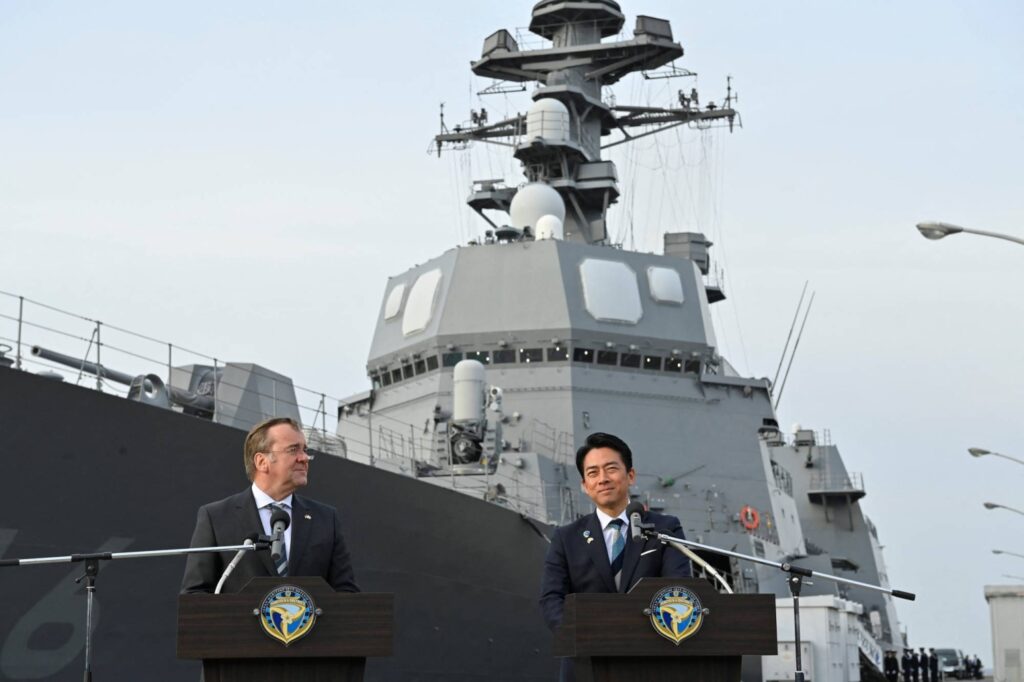
German firms are exploring opportunities to work with Japanese counterparts in areas ranging from naval systems to missiles and drones amid growing demand for interoperable and resilient defense capabilities.
Pistorius himself spoke of a wide range of potential defense-industrial cooperation areas with Japan, including in drone and counter-drone systems, something he said would have been unthinkable only a few years ago.
“There is a growing need for such cooperation so this is something we will discuss very thoroughly over coming months,” he added.
Hilmer said the two countries were looking at options to ramp up their defense-industrial capacities, particularly as they draw lessons from their support to Ukraine in defending against Russia’s invasion.
Cooperation was being explored across “all the main weapon systems,” he said.
While Germany was already discussing some specific projects with Japan, including the Airbus-led Eurodrone program, companies wanted to build new ties, he said, including those working on advanced air defense systems and quantum-related technologies.
The erosion of the international order demands that like-minded countries such as Germany and Japan cooperate more closely in order to be able to face the new challenges of our times, he noted.
The visit follows the signing of several memoranda of understanding last May on the sidelines of the DSEI Japan defense exhibition, including on joint equipment development. According to media reports, Kawasaki Heavy Industries is in talks to co-develop new engines for Germany’s Taurus cruise missiles.
There was little mention, however, of Germany’s potential participation in the Global Combat Air Program, a multibillion-dollar project between Japan, Britain and Italy to develop a sixth-generational fighter aircraft set to enter service by 2035.
Media reports have repeatedly claimed that Berlin has been considering joining the program due to persistent disputes over leadership and technical requirements in its current Future Combat Air System (FCAS) project with France and Spain.
Asked about the issue, Pistorius said it was too early to address the issue as FCAS was still a topic of discussion between German and French leaders in an attempt to improve the situation.
Meanwhile, Tokyo and Berlin also welcomed the steady expansion of bilateral defense exchanges across the land, maritime and air domains.
This includes the Bundeswehr’s increased participation in regional bilateral and multilateral exercises in recent years as well as recent milestones such as the deployment of Air Self-Defense Force F-15 fighter aircraft to Germany last September, marking the first time Japanese fighter jets had been sent to Europe.
Facilitating these joint military maneuvers is a defense pact the strategic partners signed in January 2024 designed to ease the exchange of supplies and logistical support while allowing the use of each side’s military facilities during exercises.
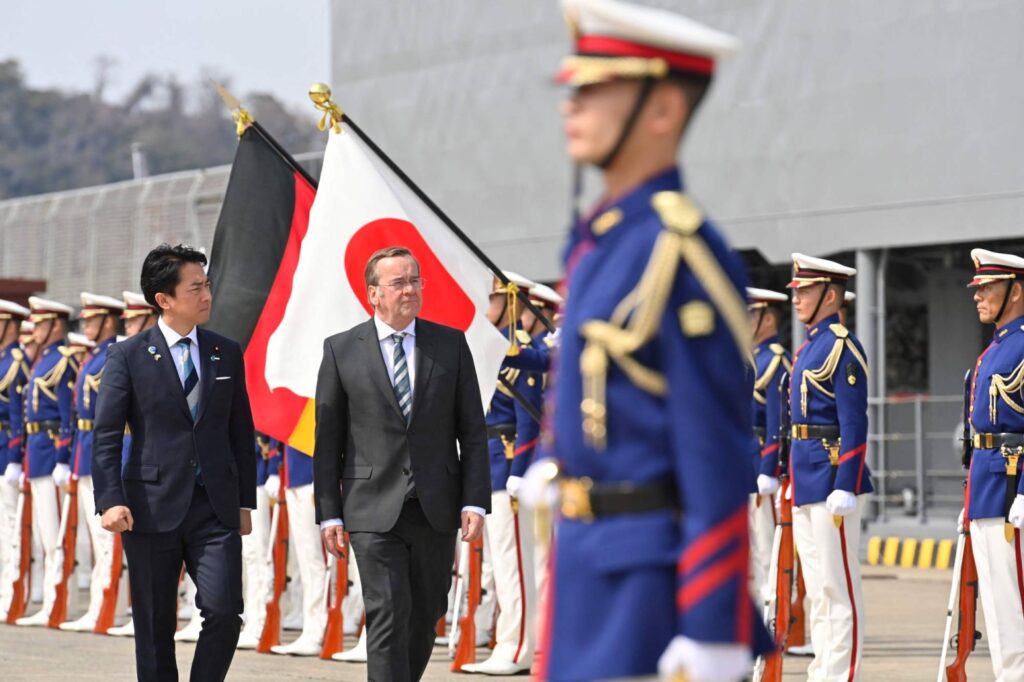
The growing military cooperation also points to an increase in interoperability between the two countries’ forces as well as their willingness to operate together beyond their immediate regions.
Risks posed by military buildups in China and North Korea, as well as the escalating situation in the East and South China Seas and around Taiwan, are of particular concern to Berlin.
Speaking to The Japan Times in August 2024, the chief of the German Navy, Vice Adm. Jan Christian Kaack, said that Berlin’s growing military engagement in the Indo-Pacific is intended to signal that it won’t accept disruptions to key international sea lanes.
People are “slowly realizing” that sea lines of communication — the vital arteries between ports used for trade, military and other purposes — “are everyone’s concern — no shipping, no shopping!,” he said less than a month before the German Navy sent two warships through the Taiwan Strait following a visit to Japan, in a move intended to assert freedom of navigation in international waters.
By linking operational cooperation with industrial collaboration, Tokyo and Berlin appear to be laying the groundwork for a more comprehensive defense partnership — one that spans from joint exercises to the potential co-development of future capabilities.
The ministers also exchanged views on regional security issues, including developments in the Indo-Pacific and the situation surrounding Iran, reaffirming their intention to maintain close coordination.
Pistorius said Japan and Germany are in agreement to contribute to appropriate efforts to ensure safe passage through the Hormuz Strait, including through demining operations, if required, but only after combat operations have ceased.