

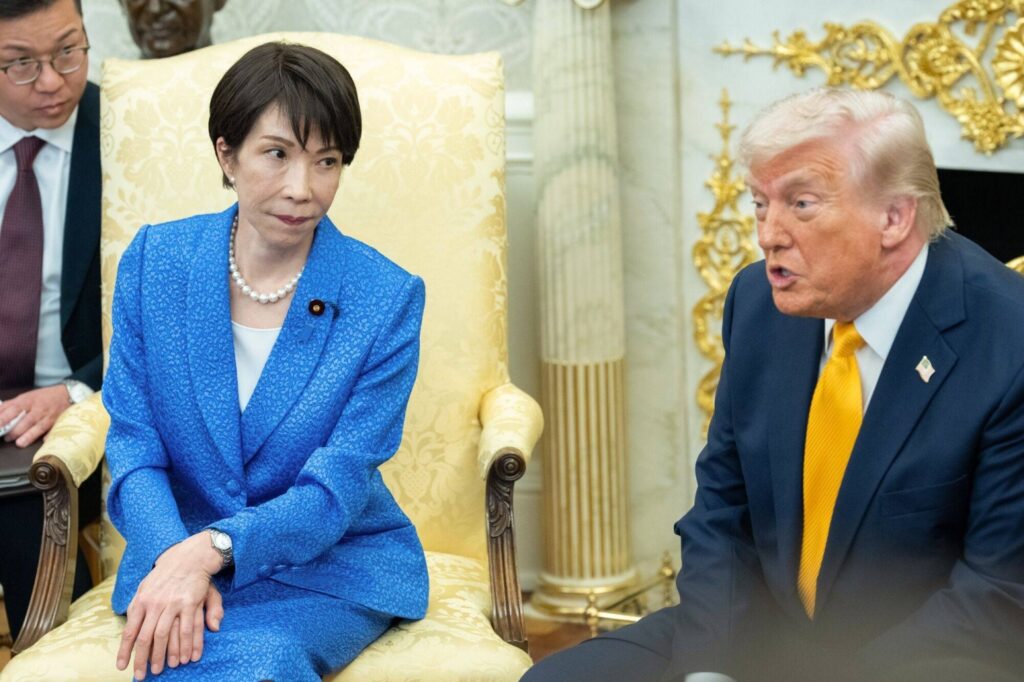
Prime Minister Sanae Takaichi has largely been praised for her handling of U.S. President Donald Trump during her first visit to Washington as Japanese leader. But a raft of challenges remain — namely improving Japan’s relationship with China and convincing Trump not to make a deal with Beijing that leaves Tokyo in the lurch.
Japanese officials faced a double punch in the runup to the summit, with the Feb. 28 eruption of war against Iran and then with the sudden postponement of Trump’s meeting with Chinese leader Xi Jinping at the end of this month.
The Takaichi administration had earlier hoped her meeting would offer a chance to bend Trump’s ear before the Xi summit, with the prime minister aiming to press him on the importance of the U.S.-Japan alliance and a need to push back against China’s coercive measures.
Takaichi is unlikely to be the last leader to speak to Trump before the Xi meeting, which the U.S. president said could be held in about a month and a half, but she did manage to secure what appeared to be an endorsement of her approach to the Sino-Japanese relationship.
At the opening of his meeting with Takaichi, Trump described Japan-China ties as “edgy,” saying he would “be speaking Japan’s praises when I’m in China with President Xi.”
Trump’s statement that he will speak positively about Japan at any meeting with Xi could be interpreted as a “modestly positive signal,” said Ryo Sahashi, a professor of international politics at the University of Tokyo — though he cautioned against overestimating its impact.
“Still, the fact that U.S.-Japan relations are broadly stable and characterized by a degree of trust is itself an asset for Japan,” he added.
Indeed, Japan now appears to occupy a relatively privileged position among U.S. allies, one arguably stronger than many European partners, especially considering Trump’s criticism of NATO before, during and after his summit with Takaichi.
“This is not simply due to Takaichi’s personal diplomacy, but also reflects Trump’s long-standing, somewhat distinct perception of Japan, which Tokyo has learned to read and leverage effectively,” Sahashi said, adding that while this may not directly resolve the China-Japan dispute, “it could provide Tokyo with some diplomatic leverage as U.S.-China relations evolve.”
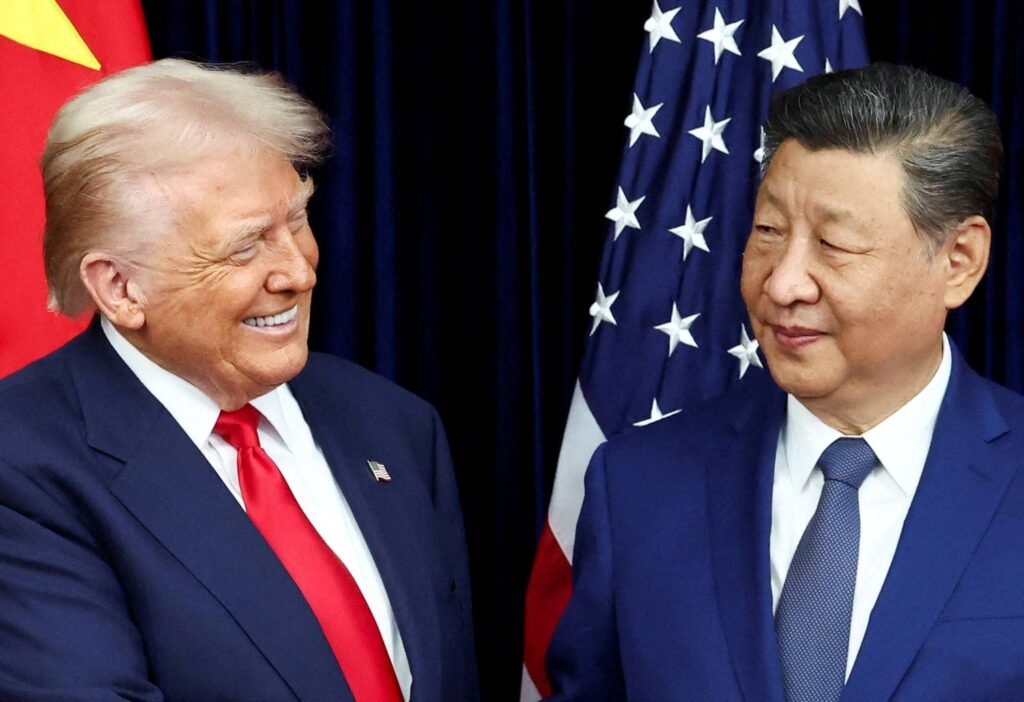
But that evolving relationship is precisely what worries Tokyo, which fears that Trump could parlay his desire for a wide-ranging deal with China into a “G2” grouping, short for a “Group of Two,” an idea broached and discarded in the early 2000s that, from Japan’s perspective, could be interpreted as Washington and Beijing dividing the Pacific Ocean between east and west, effectively creating spheres of influence.
Some experts believe that Trump’s remarks could be read in two distinct ways, including that they could provide short-term reassurance to Tokyo by indicating that Japan’s position will not be ignored in U.S.–China engagements.
“However, a more skeptical interpretation is that this praise functions as a negotiating instrument within a broader U.S.–China bargaining framework,” said Misato Matsuoka, an expert on U.S.-Japan relations and associate professor at Teikyo University. “By highlighting Japan’s cooperation, Trump implicitly increases pressure on China to offer concessions of its own.
“In this reading,” she added, “Japan is less an autonomous strategic partner than a variable within a larger transactional exchange.”
Further evidence that the U.S. and Japan are not necessarily on the same page when it comes to China was seen in a fact sheet released by the White House that touched on the most contentious issue in both countries’ relationships with China: Taiwan.
“The two leaders committed to peace and stability across the Taiwan Strait as an indispensable element of regional security and global prosperity, supported the peaceful resolution of cross-Strait issues through dialogue, and opposed any attempts to unilaterally change the status quo, including by force or coercion,” it read.
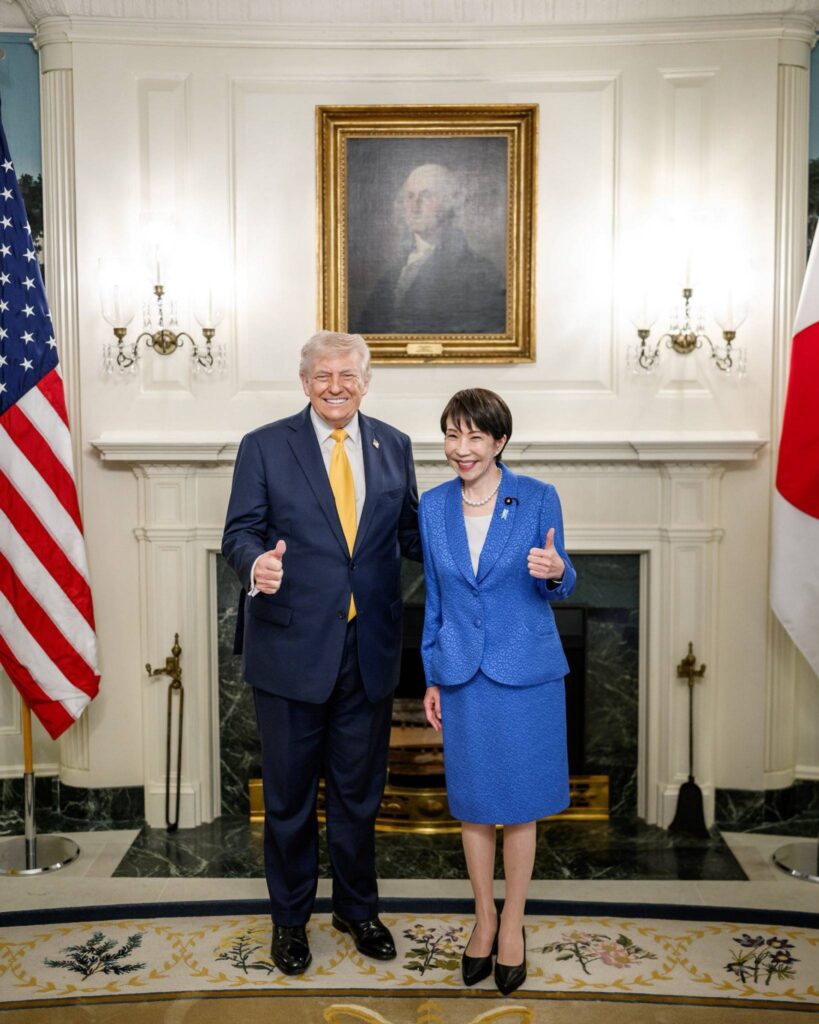
The fact sheet did not mention China by name, though it mentioned the U.S. and Japan would “coordinate in third countries to address challenges posed by strategic competitors,” an apparent reference to the allies’ participation in “minilateral” groupings with countries such as the Philippines, Australia and others in response to Beijing’s moves.
A Japanese readout of the summit released by the Foreign Ministry did not mention Taiwan, saying only that the two leaders had “exchanged views on issues concerning China and reaffirmed that Japan and the U.S. would continue to coordinate closely,” while explicitly noting cooperation with “like-minded countries.”
Asked at a regular news conference Monday about the discrepancy, Japan’s top government spokesperson, Chief Cabinet Secretary Minoru Kihara, declined to comment on diplomatic discussions, but emphasized that the fact sheet “was issued solely by the U.S. side,” adding that the two leaders had “confirmed their commitment to close cooperation” on China issues.
It was not clear whether the omission by the Japanese side was an attempt to tone down language over the contentious issue of Taiwan, which China claims as its own and has vowed to bring the democratic island under its control, by force if necessary.
Japan’s ties with China have plunged to their lowest point in decades following Takaichi’s remarks in parliament on Nov. 7 that the Self-Defense Forces could be deployed under the right to collective self-defense in “worst-case” scenarios, such as a Chinese naval blockade of Taiwan, which the prime minister said would constitute a “survival-threatening situation” for Japan.
China lashed out after the remarks, turning to a toolbox of informal economically coercive tools to punish Japan.
While U.S. officials have expressed concern about the dispute, Trump has refrained from directly expressing his support for Takaichi, apparently out of concern that doing so might disrupt plans to reach a broad trade deal with Xi.