

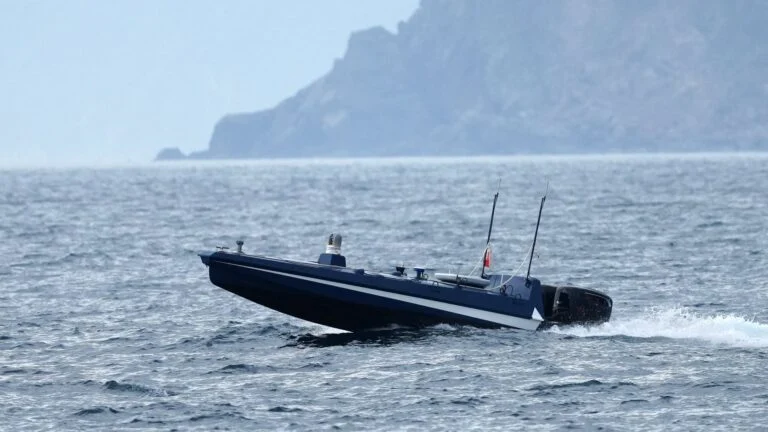
MELBOURNE — Taiwan’s current approach to defense is unlikely to deter Chinese aggression, and it needs a new operational concept that builds mass and provides operational flexibility but yet remain affordable, according to a new report.
In its report, the US-based thinktank Center for a New American Security (CNAS) also calls on the island to create an “asymmetric hellscape” made up of thousands of drones working in concert with more conventional weapons to render an invasion prohibitively costly by focusing on defeating China’s People’s Liberation Army when it is most vulnerable: during its cross-strait transit and when its troops are landing.
The report, titled Hellscape for Taiwan: Rethinking Asymmetric Defense, however also warned that Taiwan still faces hurdles in making this a reality, ranging from lacking the domestic industrial base to produce the drones at scale and institutional problems in its military.
Authors Stacie L. Pettyjohn, who is the senior fellow and director of the Defense Program at CNAS, and research assistant Molly Campbell urged Taiwan to allocate more funding for such a plan instead of continuing to “spend the bulk of its defense budget on large, exquisite prestige weapons.”
“Drones could augment Taiwan’s limited stockpile of expensive weapons with precise, affordable mass that produces cross-domain effects while reducing risk to military personal by employing uncrewed systems for the most dangerous missions,” the report says.
It would also fulfil Taiwan’s asymmetric “porcupine” strategy designed to prevent China from quickly conquering the island by directly counterattacking a conventional air and naval assault with its superior forces.
A 50-Mile Maritime Danger Zone
The report called for Taiwan to establish a multilayered 80 kilometre (50-mile) maritime hellscape stretching from the invasion beaches China’s People’s Liberation Army (PLA) will be assaulting, with different drone and weapon mixes to sink, damage or otherwise interfere with the ships bringing in the invasion forces.
“It is an operational concept supporting a defense-by-denial strategy that aims to prevent Beijing from achieving its military objective, thereby deterring an attack in the first place,” the report says. “It does so by preventing the PLA from transporting enough troops to Taiwan to conquer the island, using an approach designed to remain effective even amid extensive communications and GPS jamming.”
The first of these four layers would stretch from 40 to 80 km from the coastline and would utilize a variety of longer-ranged air, seaborne, sub-surface drones and even decoy drones working alongside conventional anti-ship cruise and supersonic missiles to saturate opposing air defenses.
“Facing mixed drone and missile raids, Chinese forces would have little time to distinguish sophisticated threats from decoys, forcing them to engage everything. This would rapidly deplete shipboard interceptors, leaving the fleet vulnerable to follow-on attacks,” it says.
This would be followed by attacks on the second layer that stretches from 5km to 40km offshore, which would see attacks on the landing craft carrying troops and equipment from the larger landing ships to shore in an effort to disrupt the PLA’s landing schedule using extensive pre-laid minefields and more drone and missile attacks as attempts are made by the attacking PLA forces to negotiate and clear these mines.
The last two layers are located from 5km to the shoreline and on the invasion beaches themselves, where shorter-range, line-of sight weapons and attack drones with autonomous terminal guidance that enables them to go the “last mile” and hit their target without operator input to nullify attempts to jam the link between the drones and their human controllers.
A Strategy Fallen Short
However, the report cautioned that Taiwan’s implementation of its porcupine strategy has so far fallen short, with the report noting that critics that include Trump administration officials, have accused Taiwan of displaying “an alarming lack of urgency” and not spending anywhere near enough despite recent increases in defense budgets.
It also said that the conservative Taiwanese military, which already suffers from personnel shortages and insufficient training, has not invested enough in these asymmetric capabilities.
“Beyond its equipment problems, Taiwan’s military suffers from serious deficiencies in manpower, training, and planning that raise doubts about its ability to resist a larger PLA force,” the report says. “Without this foundation, military planners struggle to justify procurement decisions, commanders cannot develop realistic training scenarios, and units lack a shared understanding of how they would actually fight.
“The result is a force that may possess the right equipment but lacks the intellectual framework to employ it effectively.”
The paper also called for Taiwan to redirect more of its spending towards the domestic defense industry to manufacture drones locally, noting that President Lai Ching-te’s additional special budget for defense has allocated only 300 billion New Taiwan dollars ($9.6 billion) on locally made weapons and three times that amount on weapon systems imported from the US.