
Newsletter Subscribe
Enter your email address below and subscribe to our newsletter
Enter your email address below and subscribe to our newsletter

 Byadmin
BEIJING: A week in which long-time tensions between neighbours China and Japan ratcheted up economically end politically drew to a close with no sign of improvements Friday (Jan 9) as the Chinese ambassador in Tokyo rebuffed his host nation and the Japanese reported delayed shipments to suppliers in China because of the spat.
The two developments capped a week where China made clear its displeasure with Japan by instituting new export controls, condemning what it called Tokyo’s renewed militarism and cozying up to another regional neighbour, South Korea, during its leader’s visit to Beijing.
On Friday, the Chinese Communist Party’s flagship newspaper, People’s Daily, kept the jabs coming.
“New militarism will lead Japan back into the abyss,” it said in an editorial. “History serves as a stark warning, yet the Japanese right wing is repeating its old tricks.”
It was the latest in several days of pointed Chinese criticism toward Japan after its prime minister, Sanae Takaichi, suggested in November that she wouldn’t rule out intervening if China used military force against the island of Taiwan. China views self-governed Taiwan as its sovereign territory and has said it would take it by force if needed. It staged large-scale military exercises nearby late last month.
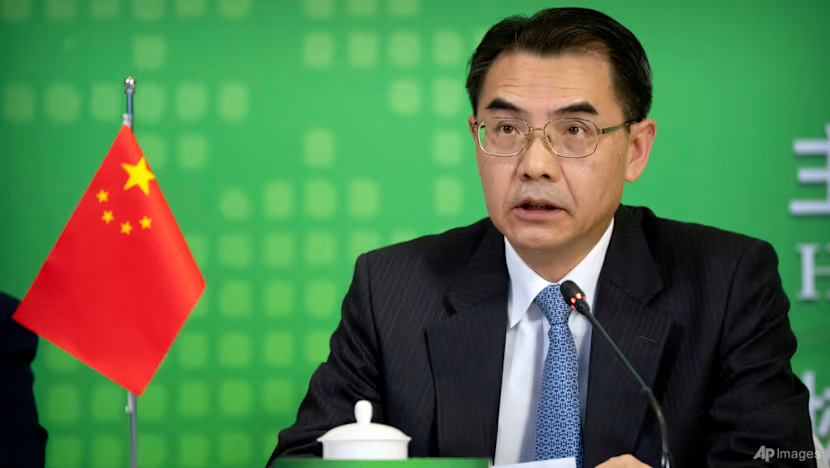
On Thursday night, the Chinese embassy in Japan said it had rejected a petition from Japan’s Foreign Ministry to retract the new export controls on “dual-use items” that the Japanese military might be able to use in weaponry. The ambassador, Wu Jianghao, insisted that China’s move was “entirely legitimate, reasonable and lawful” – and vital to national security.
Also Friday, Japanese officials said they are closely watching if Japanese exports of agricultural, fisheries and other goods are appropriately handled by China without delays. The Japanese news agency Kyodo reported that outgoing shipments of sake and processed food from Japan to China were being held up because of the diplomatic tensions, widening the ripples of the dispute.
Quoting trade industry sources, Kyodo said the shipments were delayed in customs on the China side. It said the sources believed the sake may have been targeted as “a symbol of Japan.”
Japan’s chief cabinet secretary, Minoru Kihara, said he was aware of reports that some of the Japanese exports to China have been held up. He wouldn’t comment on individual commercial transactions.
“It is important that agricultural, fisheries and other exports from Japan are smoothly carried out,” Kihara said. “We will closely watch the situation and take appropriate measures.” He didn’t say what those might be.
Japan and China have a fraught history haunted by the Japanese colonization of Taiwan in 1895. The nations have fought two wars, and the imperial government in Tokyo brutally occupied parts of China in the first half of the 20th century. The countries maintain diplomatic relations and work closely together on many fronts but occasionally use government apparatus to condemn each other when disputes arise.
China’s choice of wording in the People’s Daily editorial and other rhetoric was noteworthy. It avoided casting a broad brush on the Japanese people and specifically targeted the country’s right wing, which Takaichi belongs to. A report Thursday about Japan’s nuclear ambitions repeatedly mentioned the right wing, and the People’s Daily editorial beseeched the “peace-loving Japanese people” to be “highly vigilant” toward their government.
“Japan’s future lies not in the dangerous fantasies painted by the right wing, but in the thorough reckoning with its history of aggression,” People’s Daily said.